
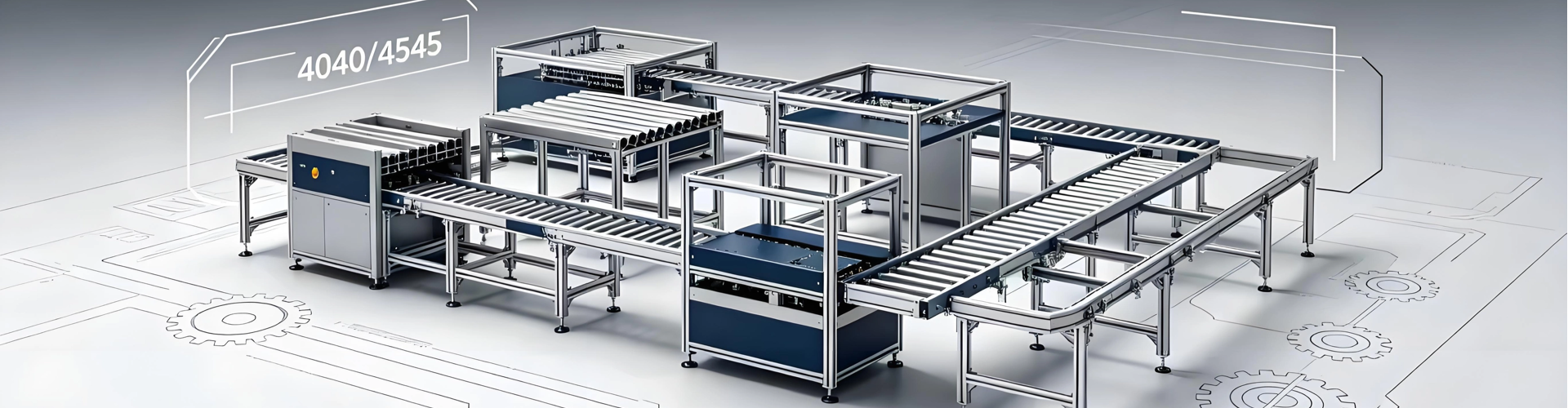
Lightweighting is moving beyond product design into equipment manufacturing and production-line construction. For industry, this is not simply a matter of replacing materials; it brings simultaneous changes to efficiency, cost, maintenance, and delivery. As a result, demand for custom aluminum profile machining has continued to rise over the past two years, and the market is shifting from standard supply toward integrated services that place greater emphasis on application-specific solutions.
Growing Demand: The Real Drivers Behind Lightweighting
In the past, discussions of lightweighting often brought automobiles or consumer electronics to mind. Today, lightweighting has also become an explicit requirement in industrial automation, smart manufacturing, new energy equipment, medical equipment, and warehousing and logistics equipment.
The reasons are straightforward. Equipment is increasingly designed to be modular, production lines need greater adjustability, and on-site delivery places more emphasis on installation efficiency. Although traditional steel structures offer high strength, their weight, processing lead times, surface treatment requirements, and the cost of subsequent modifications are often less flexible.
Industrial aluminum profiles fill this gap. They combine strength, light weight, corrosion resistance, and reusability, making them suitable for a wide range of applications, including equipment frames, safety guards, conveyor lines, workbenches, and peripheral structures for robots.
When customers no longer want to buy just a length of profile, but instead expect solutions that include cutting, drilling, tapping, CNC machining, and even complete assembly, custom aluminum profile machining becomes a core part of the purchasing decision rather than an additional service.
Custom Aluminum Profile Machining Is More Than “Cutting to Drawing”
The key change behind many shifts in market demand is not the material itself, but what is included in the delivery. The value of custom aluminum profile machining goes beyond cutting standard profiles to specified lengths.
A more complete understanding should cover several aspects: whether the profile selection suits the load requirements, whether the connection method facilitates assembly, whether hole positions and machining precision meet equipment installation requirements, whether the surface treatment suits the operating environment, and whether future expansion will be convenient.
In other words, mature custom aluminum profile machining is really about “structural adaptation” and “delivery optimization.” This is why, even with common specifications such as 4040, 6060, and 8080, project outcomes can vary greatly depending on the supplier’s capabilities.
Integrated Capabilities Are in Greater Demand
The single-product sales model can no longer meet the needs of complex projects. What is attracting greater attention today is the ability to provide a continuous service, from mold design and profile extrusion to precision machining and assembly delivery.
Looking at the business operations of Shanghai Xiangda Industrial Aluminum Profiles Co., Ltd., its core strength lies in coordinating the R&D, production, sales, and custom machining of industrial aluminum profiles, enabling it to respond more quickly to requests for drawing-based customization, non-standard product development, batch machining, and urgent supply.
This capability is particularly important in the manufacturing environment of the Yangtze River Delta. Project schedules are tight and lead times are under increasing pressure. To handle the growth in orders, suppliers need to understand standard specifications while also offering deep processing and frame assembly.
Which Applications Are Driving Market Interest?
Across industries, the growth in demand for custom aluminum profile machining is not driven by any single sector. Instead, it comes from the simultaneous expansion of equipment applications across multiple sectors.
These applications have one thing in common: standard components remain important, but cannot complete a project on their own. Processing and related services are needed to turn standard profiles into structural units that are ready for implementation.
For example, the 6060 series is widely used in medium- and large-sized frames, offering a balance of structural stability and expandability. In actual solutions, specifications such as XD-6-6060G are better suited to applications that require a balance between load-bearing capacity and assembly, rather than being chosen based on the model number alone.
Market Opportunities Come from More Than Rising Demand
Demand growth is only part of the picture. More importantly, customers are changing how they evaluate suppliers, creating structural opportunities for channel partners.
In the past, comparisons focused more on price, inventory, and standard specifications. Now, customers more often compare delivery completeness, technical response speed, support for small-batch samples, non-standard product development capabilities, and the consistency of subsequent volume production.
This means that suppliers who can upgrade from “material supply” to “application-specific solutions” are more likely to build long-term partnerships. This is especially true in automation equipment, new energy equipment, electronic equipment, and medical equipment, where project-based orders depend more on ongoing collaboration.
Headquartered in Songjiang, Shanghai, Shanghai Xiangda Industrial Aluminum Profiles Co., Ltd. builds on its location in the Yangtze River Delta and its mature supply chain. Starting with national-standard and European-standard industrial aluminum profiles and accessories, the company also provides cutting, drilling, tapping, CNC machining, surface treatment, and frame assembly. This business model aligns with the current direction of market change.
Why Can One-Stop Services Help Grow Orders?
- Fewer subcontracting steps make delivery schedules more controllable.
- When drawings are revised, communication channels are shorter.
- For repeated production, precision and assembly consistency are more stable.
- Support is available for samples, small batches, and large-scale production.
- Accessories such as fittings, connectors, seals, and casters are easier to match as a complete set.
What to Look at When Assessing Opportunities in Custom Aluminum Profile Machining
Judging this market by sales volume alone can easily lead to underestimating its potential. A more reliable approach is to look at the structure of demand and the depth of delivery services.
One signal worth noting is that customers are getting involved in structural discussions earlier. When they start discussing profile selection, connectors, machining methods, and surface treatment at the drawing stage, it indicates greater reliance on customization capabilities.
Another signal is the shift in repeat-purchase patterns. Repeat purchases of standard profiles are usually driven by inventory needs, while repeat purchases involving custom aluminum profile machining are often driven by project replication, equipment expansion, and product-line development, resulting in stronger customer retention.
In general, opportunities can be assessed across the following dimensions:
- Is there a reliable supply of mainstream specifications such as 2020, 3030, 4040, 6060, and 8080?
- Is there a supporting range of accessories, rather than just the main profiles?
- Can the supplier handle deep processing while maintaining consistency across batches?
- Does the supplier follow the ISO9001 quality management system to ensure process stability?
- Can the supplier handle urgent deliveries and non-standard product development?
These dimensions determine not just whether a single transaction is completed, but whether the supplier can continue to support structural upgrades in future industrial projects.
Given Current Trends, How Should Businesses Prepare for the Next Stage?
The custom aluminum profile machining market is still growing, but opportunities are not evenly distributed. Stable demand is more likely to develop in areas closely connected to automation, flexible manufacturing, and frequent equipment upgrades.
Rather than simply expanding the range of models offered, it is better to first identify high-frequency applications. Equipment frames, safety guards, conveyor lines, workbenches, and peripheral structures for robots, for example, are more likely to support standardized solutions and repeat business.
At the same time, building capabilities in sample support, drawing response, accessory matching, and assembly services is more sustainable than competing on price alone. Common specifications such as XD-6-6060G should also be evaluated in the context of specific applications rather than by model parameters in isolation.
For a more detailed assessment of this market’s potential, an effective approach is to first identify lightweighting needs in existing customer projects, then compare structural types, processing depth, delivery lead times, and repeat-purchase frequency to develop a tailored list of opportunities. This makes the direction for custom aluminum profile machining clearer and makes action easier to implement.
Related News
- ▶ Moving Forward Together, Achieving Shared Success | On October 10, Shanghai Xiangda Industrial Aluminum Profiles welcomed customers and partners for a visit and inspection
- ▶ Why Do Custom Aluminum Extrusion Die-Opening Prices Vary So Widely? What Are the Key Factors Affecting the Quote?
- ▶ How to Choose Between 6063 and 6061 Alloys for Custom Aluminum Extrusion Dies?
Leave a Message Online

Thank you very much for writing to us. Please leave your message and contact information, we will reply to you within 24 hours.