
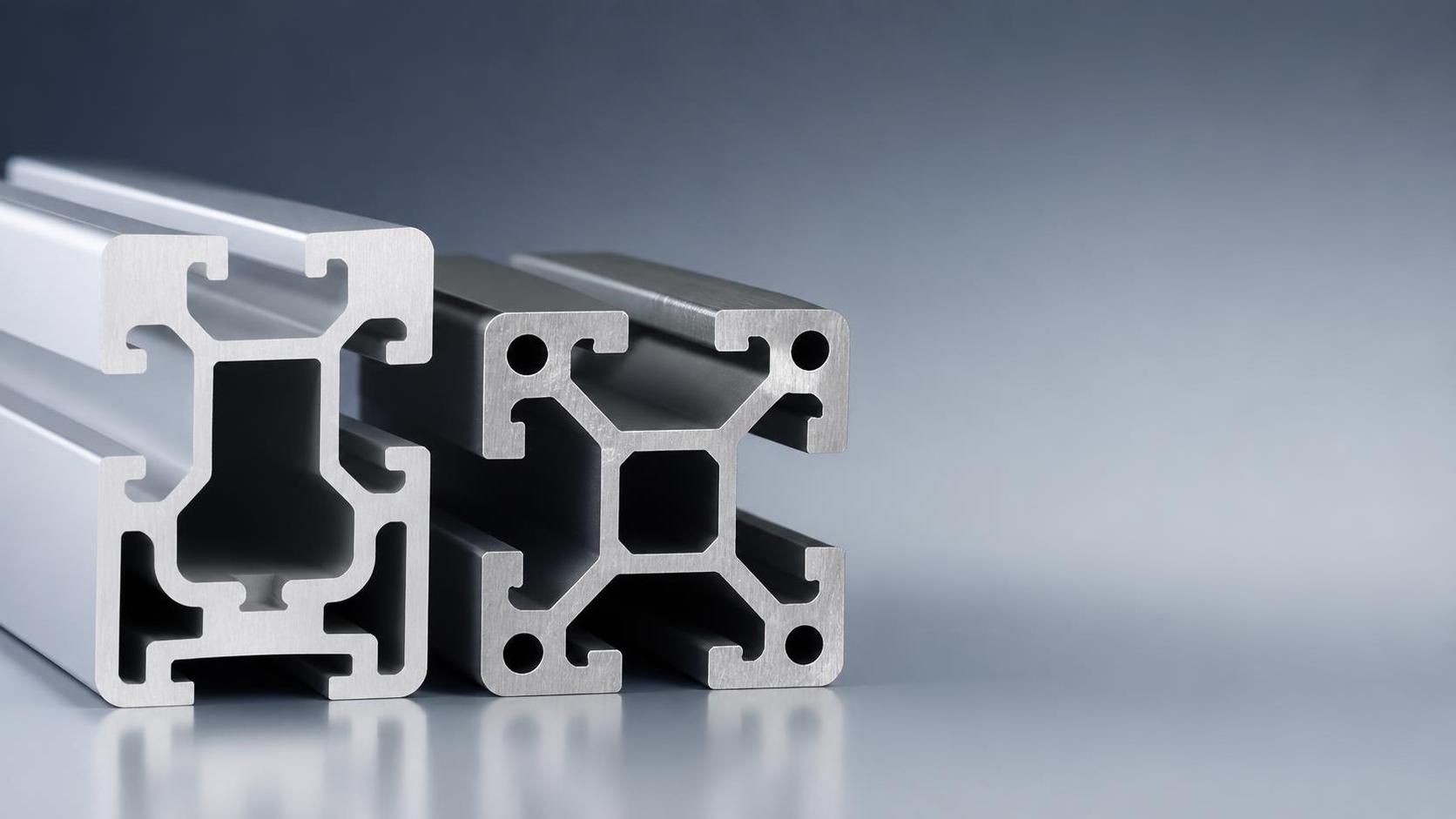
When developing a custom aluminum extrusion die, choosing between 6063 and 6061 is one of the first decisions engineers and procurement professionals face. Both are heat-treatable aluminum-magnesium-silicon alloys, but they differ significantly in composition control, mechanical properties, and extrusion processes. Applying standard-profile material selection criteria without adjustment can lead to insufficient strength or excessive costs in custom products.
Key Differences Between 6063 and 6061
6063 aluminum alloy uses magnesium and silicon as its main alloying elements, with magnesium content of approximately 0.45%–0.9% and silicon content of approximately 0.2%–0.6%. This composition gives it excellent extrudability and good flow characteristics, making it suitable for custom profiles with complex cross-sections and thin walls. Typical tensile strength is approximately 160 MPa in the T5 temper and 205 MPa in the T6 temper. Its moderate hardness also gives it a more lustrous and uniform finish after surface treatment than 6061.
In addition to magnesium and silicon, 6061 aluminum alloy contains 0.15%–0.4% copper and approximately 0.15% chromium. The copper significantly increases the alloy’s strength: in the T6 temper, its tensile strength can exceed 290 MPa and its yield strength is approximately 240 MPa, about 1.5 times that of 6063. However, 6061 is more difficult to extrude and requires tighter control of die design, extrusion temperature, and speed. Thin walls and complex cross-sections are more prone to insufficient extrusion pressure, rough surfaces, and out-of-tolerance dimensions.
Material Selection for Custom Die Development
The choice of alloy first depends on the loads the profile will bear in an equipment frame or structural component. If a custom profile is primarily used for load-bearing, support, or connection, and will be subjected to sustained static or cyclic loads, 6061’s strength advantage can be significant. For example, 6061 can reduce profile wall thickness or cross-sectional dimensions—and thus overall weight—in applications such as equipment bases, robotic arm mounting brackets, and main beams for heavy-duty conveyor lines.
For custom profiles with higher appearance requirements, lower loads, or primarily protective or guiding functions, 6063 can meet the requirements while offering lower extrusion costs and longer die life. Examples include safety-guard frames, crossbeams for light-duty workbenches, cable ducts, and covers. 6063’s machinability and surface finish make it easier to control costs in these applications.
Differences in Extrusion Processes and Die Design
6063 and 6061 have different die design requirements for custom profiles. 6063 has lower resistance to deformation, and its flow through the die is easier to control, allowing for more complex cavities, slots, and thin-wall structures. Because 6061 is stronger, the die is subject to greater stress during extrusion. Sharp corners, deep grooves, and very thin walls are more prone to stress concentrations, which can cause premature die wear or breakage.
In production, 6061 extrusion speeds typically need to be 20%–30% lower than those for 6063; otherwise, coarse-grain rings or cracks may appear on the profile surface. For custom die development involving complex cross-sections and uneven wall thicknesses, it is advisable to assess the feasibility of 6063 first, unless strength requirements are non-negotiable. Choosing 6061 without careful consideration may instead lead to more die modifications and a longer development cycle.
Effects of Heat Treatment and Surface Treatment
Both alloys can achieve different mechanical properties through the T5 or T6 temper. T5 involves air or water-mist cooling immediately after extrusion, followed by artificial aging. T6 requires solution heat treatment after extrusion, followed by quenching and then artificial aging. 6063 achieves good overall properties in the T5 temper at a lower cost. 6061 typically requires the T6 temper to reach high strength, and the solution heat treatment and quenching steps add process complexity and energy consumption.
For surface treatment, anodized 6063 has a uniform oxide layer and consistent color, making it well suited to custom profiles that require a natural anodized finish or coloring. Due to its higher copper content, 6061 may develop color variations or dark spots in the anodized layer. Dark-colored anodizing or coating can conceal these issues. If a custom profile requires a bright silver-white anodized finish, 6063 is the more reliable choice.
Balancing Cost and Lead Time
The cost of developing a die for a custom aluminum profile includes the die, material, extrusion, and subsequent processing. Die costs for 6063 are typically 10%–15% lower than for 6061 because the dies wear less and require fewer repairs. The price per ton of 6061 is 8%–12% higher than that of 6063, depending on market conditions. Taking differences in heat and surface treatment into account, the total cost of custom 6061 profiles may be more than 20% higher.
Lead time also needs to be considered. 6063 extrudes faster and requires less time for die setup, allowing small-batch samples to be produced in 15–20 days. Because 6061 extrudes more slowly and requires additional heat treatment, the same custom die project may take 25–35 days. If the project schedule is tight and the strength requirements are not particularly demanding, choosing 6063 can significantly shorten delivery time.
Common Misconceptions and How to Decide
Some engineers habitually choose 6061 when designing custom profiles, believing that “higher strength is always better.” In reality, stiffness is often more important than strength in frame structures. The cross-sectional moment of inertia and wall thickness have a much greater effect on stiffness than the material itself. If increasing wall thickness or optimizing the cross-section of a 6063 profile can meet the stiffness requirements, there is no need to choose 6061.
Another common oversight is 6061’s welding performance. Welding reduces the strength of the heat-affected zone, and restoring some of the lost strength requires post-weld heat treatment, which is difficult to carry out in practice. 6063 has better weldability and loses less strength after welding. For custom frames that require welded assembly, 6063 is the more practical choice.
The decision process is straightforward: first, determine the maximum load, operating environment, and assembly method for the custom profile. Consider 6061 if the load is clearly defined and exceeds the allowable stress for 6063 in the T6 temper, or if the profile must withstand torsion and impact. For standard support, protection, or positioning applications, 6063 is fully adequate. You can also refer to existing standard profiles. For example, if the loading conditions of a modified custom cross-section are similar to those of a common market specification such as XD-8-4040L, the same alloy can be used.
Additional Application Considerations
Custom profiles often need to be used with accessories and connectors. 6061 profiles are harder, which increases tool wear during drilling and tapping. The resulting threads are indeed stronger, but machining productivity is lower. 6063 is easier to machine and is suitable for high-volume positioning operations; its thread strength is already sufficient for typical applications. If a custom profile needs multiple corner brackets or bolts installed, the ease of machining 6063 can reduce overall assembly costs.
Both alloys have good corrosion resistance, but 6063 is slightly more corrosion-resistant than 6061, particularly in acidic or alkaline environments or under damp conditions. Copper in 6061 may cause pitting corrosion in certain media. For custom profiles used in outdoor equipment or food-processing environments, 6063 is the preferred option; alternatively, 6061 profiles can be protected with a coating.
Summary
There is no universally better choice between 6063 and 6061; the right alloy depends on the actual requirements. Decisions about custom aluminum extrusion dies should be based on a comprehensive assessment of strength calculations, cross-sectional complexity, surface requirements, budget, and lead time. 6063 offers a balance of cost and processability and is suitable for most custom applications. 6061 prioritizes strength and is suited to structures with clearly defined loads and relatively simple cross-sections. Understanding the limits and characteristics of each alloy helps ensure the best return on investment in die development.
Related News
- ▶ Moving Forward Together, Achieving Shared Success | On October 10, Shanghai Xiangda Industrial Aluminum Profiles welcomed customers and partners for a visit and inspection
- ▶ Why Do Custom Aluminum Extrusion Die-Opening Prices Vary So Widely? What Are the Key Factors Affecting the Quote?
- ▶ How to Choose Between 6063 and 6061 Alloys for Custom Aluminum Extrusion Dies?
Leave a Message Online


Thank you very much for writing to us. Please leave your message and contact information, we will reply to you within 24 hours.