
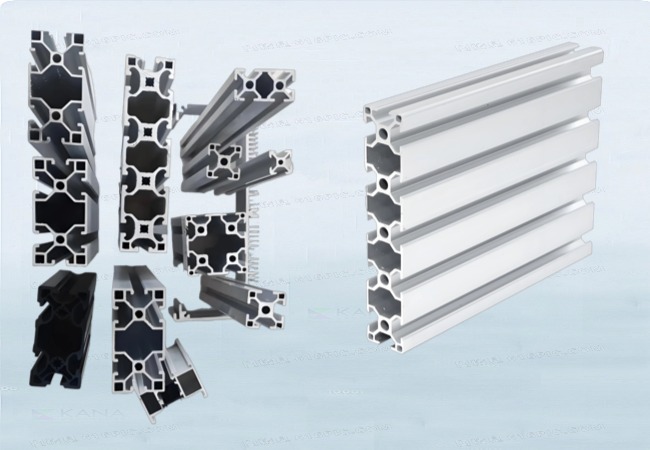
When people search for “where is a reliable place to buy industrial aluminum profiles,” they are essentially not asking about the name of a sales channel, but about a more practical concern: if this purchase goes wrong, will they continue to pay the cost in assembly, delivery delays, rework, and after-sales service? Especially for projects involving equipment frames, safety guards, conveyor lines, and workbenches, the aluminum profiles themselves are often not the most expensive part of the overall solution, but once a problem occurs, they are among the factors most likely to delay the progress of the entire machine.
Therefore, when deciding “where to buy,” the focus should not be limited to the price list. It is more important to determine whether the supplier can handle materials, machining, accessories, assembly, and replenishment. For industrial procurement, reliability usually means three things: consistent specifications, stable delivery, and someone who takes responsibility when problems arise.
The conclusion first: compared with “which platform to buy from,” it is more important to know “what type of supplier to buy from”
If you only need to temporarily purchase a few standard profiles for simple tooling, e-commerce platforms, trading companies, and ready-stock channels may be sufficient. However, once a project enters the stages of equipment manufacturing, production-line modification, or batch delivery, the procurement logic changes. At this point, it is more appropriate to prioritize manufacturers with actual production and machining capabilities. The reasons are straightforward:
- It is easier to maintain consistency in profile cross-sections, slot shapes, tolerances, and surface treatments;
- Accessories are more compatible, reducing problems where components can be installed but do not work properly;
- Cutting, tapping, drilling, and CNC machining can be completed together, reducing errors caused by transferring orders between suppliers;
- During later additions, drawing revisions, and repeat orders, inconsistencies between batches are less likely to occur;
- When delivery schedules fluctuate, coordination is easier and information does not have to be relayed through multiple layers.
This is also why many equipment manufacturers and automation integrators, once they enter the formal project stage, no longer focus only on online quotations. Instead, they pay more attention to whether a supplier has complete supporting capabilities covering extrusion, machining, and assembly.
“Reliable” is not an empty phrase. At a minimum, these points should be considered during procurement
1. The completeness of the specifications determines whether you will need to repeatedly change your solution later
A common problem in industrial aluminum profile procurement is that samples can be produced at the early stage, but a certain specification becomes unavailable during later batch production, forcing design modifications. For example, mainstream specifications such as 2020, 3030, 4040, 4080, 6060, and 8080 may appear common, but different projects have different sensitivities to wall thickness, slot type, connection method, and load-bearing requirements. A supplier having stock does not necessarily mean that it can provide the same series consistently over the long term.
The questions that are truly worth asking are: Does the supplier consistently handle mainstream national-standard and European-standard series? Are standard specifications continuously stocked? Can expanded orders and repeat orders continue to use the same system? Otherwise, the purchasing price saved at the beginning may later be offset by design changes and assembly compatibility problems.
2. A supplier that only sells profiles may not be suitable for project work
Industrial aluminum profiles are different from ordinary raw-material procurement. In many projects, the problem does not lie in the aluminum profile itself, but in the connection between accessories and machining. If auxiliary materials such as corner brackets, bolts, nuts, connectors, sealing strips, and casters do not come from the same supply system, issues such as difficult slot fitting, insufficient fastening, and low installation efficiency often arise on site.
Taking this a step further, if a supplier can only sell raw materials while cutting, drilling, tapping, and surface treatment have to be arranged with other suppliers, the boundaries of responsibility become unclear. When hole-position deviations, length errors, or assembly interference are discovered on site, it is often difficult to quickly determine whether the cause is the drawing, the machining, or the compatibility between the profiles and accessories.
Therefore, for equipment-related procurement, manufacturers that can provide one-stop supporting services are usually more convenient—not because they have a bigger name, but because they create fewer problems and shorten the communication chain.
3. Stable delivery is more important than fast quotations
Many purchasers are easily attracted at the early stage by offers such as “quotation on the same day and shipment the next day.” However, actual industrial projects often do not end with a single order. There may later be drawing revisions, material replenishment, urgent orders, and delivery in batches. At this point, the supplier’s response speed and supply-chain coordination capabilities truly demonstrate their value.
A reliable supplier usually has a clear understanding of which products are standard items in stock, which require production scheduling, and which deep-processing procedures will extend the lead time. It will also remind you of delivery risks in advance. Conversely, if a supplier only gives vague promises and then says “this batch will need to wait” when the delivery date arrives, project management will become very passive.
For equipment-manufacturing customers in the Yangtze River Delta and across China, industrial aluminum profile manufacturers in Shanghai and its surrounding areas are often prioritized for an important reason: the supply chain is mature and logistics can be organized quickly, making them particularly suitable for projects requiring frequent replenishment and urgent coordination.
Several common misconceptions that many purchasers easily fall into when handling a project for the first time
Misconception 1: The lowest price is always the most cost-effective
Industrial aluminum profile procurement should not be evaluated only by the unit price per meter. A more reasonable approach is to consider the total cost. Low-priced materials may result in high cutting waste, low assembly efficiency, a high rework rate, and incompatible accessories, ultimately making the overall cost higher. Especially in automation equipment projects, the costs of assembly labor, downtime, waiting, and reworking components are often far greater than the price difference between profiles.
Misconception 2: If the sample has no problems, the batch will have no problems either
Many problems cannot be identified during the sampling stage. It is only during batch production that issues involving dimensional consistency, surface-treatment stability, repeated hole-position accuracy, and accessory compatibility become apparent. Therefore, when requesting a quotation, you should ask not only for samples, but also about batch-processing capabilities, quality-control methods, and consistency in subsequent repeat orders.
Misconception 3: Once the drawings are provided, everything is taken care of
Some purchasers assume that “machining according to drawings” means the supplier is fully responsible for everything. In reality, if the drawings do not clearly specify load conditions, connection methods, installation space, surface requirements, and assembly sequence, problems may still arise later. Reliable manufacturers generally do not accept orders mechanically; instead, they provide feedback on structural rationality, machining feasibility, and material compatibility. This early communication actually helps customers reduce rework.
Which procurement scenarios are more suitable for dealing directly with an actual manufacturer?
The following types of requirements are generally not well suited to being fulfilled solely by piecing together orders from scattered channels:
- Projects with clear structural requirements, such as equipment frames, automated production lines, and safety fences;
- Orders requiring deep-processing support such as cutting, drilling, tapping, and CNC machining;
- Customers with ongoing repeat orders or periodic replenishment requirements;
- Equipment-manufacturing projects involving many non-standard structures and frequent drawing revisions;
- Engineering orders with tight delivery schedules that require technical coordination and rapid response.
These projects place greater emphasis on whether the supplier genuinely understands industrial application scenarios, rather than simply moving materials. Industrial aluminum profile companies in Shanghai that have long served the automation equipment, intelligent manufacturing, new energy equipment, medical equipment, and warehousing and logistics industries are more likely to be included on procurement lists because they can make “material supply” part of a “scenario-based solution.”
If you are in Shanghai or the Yangtze River Delta, supplier screening can be more specific
Regional procurement offers a practical advantage: factory visits, sampling, verification, and replenishment can all be handled more efficiently. Industrial belts centered on Songjiang in Shanghai, Suzhou, Wuxi, Changzhou, Ningbo, and other areas have gathered relatively mature resources for industrial aluminum profiles and supporting machining. For equipment manufacturers, choosing a supplier in the Yangtze River Delta generally means a shorter response radius.
However, being geographically close does not necessarily mean being reliable. It is recommended to apply the following specific screening criteria:
This information is more valuable for evaluation than simply saying, “Our quality is very good.”
Why do many purchasers ultimately prefer one-stop suppliers?
In actual business, one-stop supply is not a marketing concept, but a matter of industrial procurement efficiency. The greatest value of a supplier that can cover mold design, profile extrusion, precision machining, and finished-product assembly is not that it “does everything,” but that it brings the communication and errors originally scattered across several stages together in one place.
Take an equipment-frame project as an example. If aluminum profiles, accessories, machining, and assembly are assigned to multiple suppliers, any dimensional deviation may be magnified on site. If an experienced actual manufacturer coordinates the work, drawing evaluation, material selection, machining rhythm, and assembly logic are often more coherent. For purchasers, this means lower coordination costs; for engineers, it means fewer on-site problems.
Companies such as Shanghai Xiangda, which are based in the Yangtze River Delta and have long served industrial automation and equipment-manufacturing scenarios, are included on many customers’ lists of potential suppliers for the same reason: they not only sell standard profiles, but can also undertake accessory support, deep processing, and frame assembly, making them suitable for projects requiring stable delivery and ongoing coordination. However, whether a supplier is suitable for you still depends on your order type, delivery requirements, and the depth of technical cooperation needed.
Finally, before asking “Which supplier is the cheapest?”, clarify these three questions first
First, are you purchasing “raw materials” or “semi-finished products that can be directly assembled”? The corresponding types of suppliers are completely different.
Second, is there a possibility that you will need additional orders, drawing revisions, or repeat orders later? If so, you cannot look only at the quotation for the first order; you also need to consider long-term stability.
Third, what are you most concerned about if a problem occurs: unstable quality, delayed delivery, or on-site rework? Once you rank the risks you fear most, it becomes easier to screen suppliers.
Ultimately, the question of where to buy reliable industrial aluminum profiles is not a shopping question, but a supply-chain evaluation question. The supplier that can genuinely support your project in terms of specifications, machining, accessories, delivery, and subsequent coordination is the more reliable choice. The sales channel is only the final step.
Related News
- ▶ Why Do Custom Aluminum Extrusion Die-Opening Prices Vary So Widely? What Are the Key Factors Affecting the Quote?
- ▶ Where to Buy Industrial Aluminum Profiles from a Reliable Supplier
- ▶ What Products and Projects Are Suitable for Custom Aluminum Profile Processing? An Overview of Common Industry Applications
Leave a Message Online

Thank you very much for writing to us. Please leave your message and contact information, we will reply to you within 24 hours.