
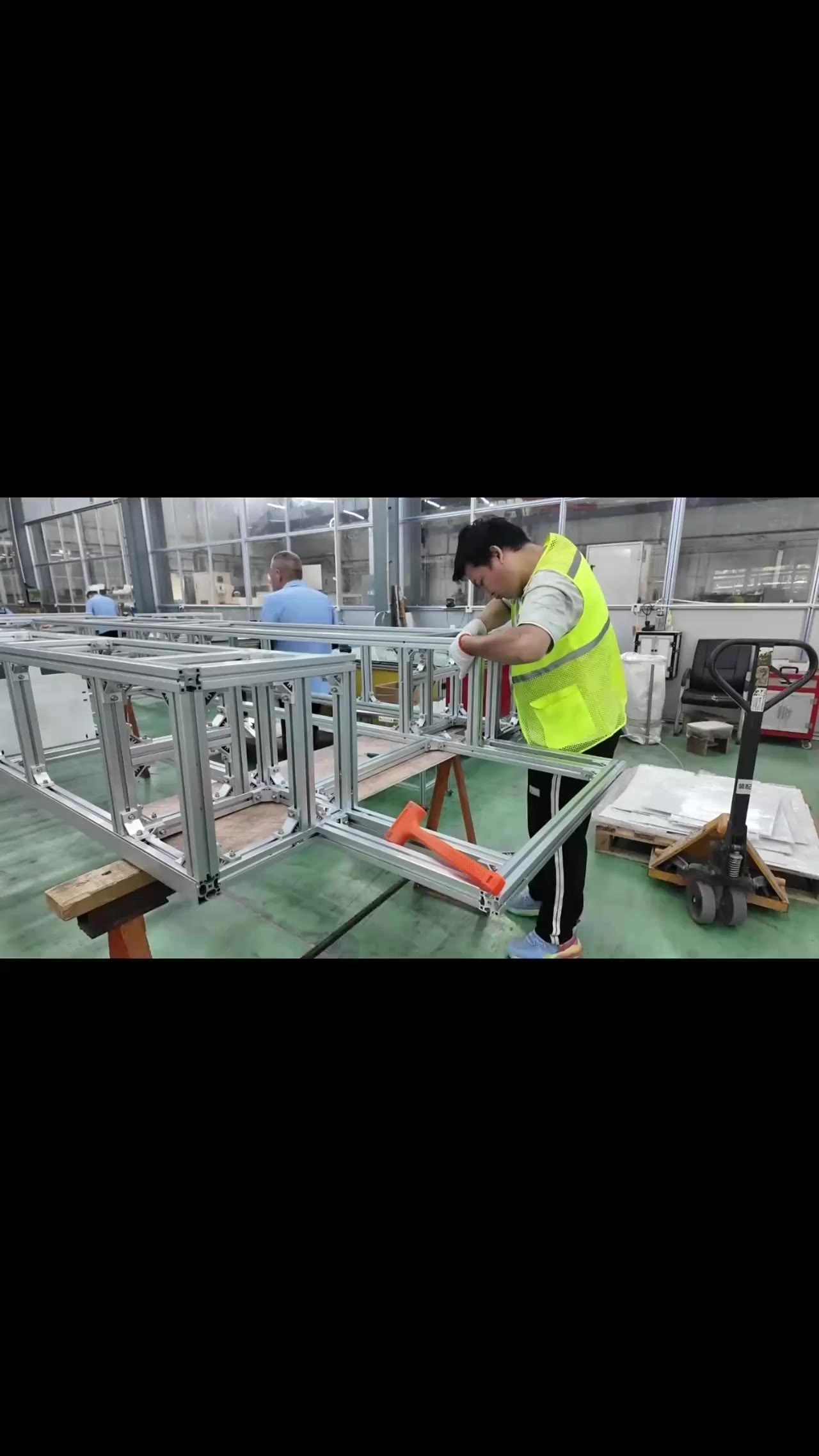
When customers are first building machine frames, structural frames, or equipment enclosures, they often wonder: which should they choose, European-standard 3030 or 4040 aluminum profiles? Both are among the most commonly used basic European-standard profiles. They share the same 8 mm slot and most accessories are compatible, but they differ significantly in load capacity, applications, and price. Choosing the wrong one can result in a shaky frame and wasted budget.
1. Basic Specifications Compared (European Standard, 8 mm Slot)
✅ European-standard 3030 aluminum profile
- Cross-section: 30mm×30mm
- Slot: 8mm (standard European slot)
- Typical wall thickness: 1.4mm / 2.0mm (heavy-duty version)
- Material: 6063-T5, primarily silver-white anodized
- Features: Lightweight, low cost, and flexible assembly
✅ European-standard 4040 aluminum profile
- Cross-section: 40mm×40mm
- Slot: 8mm (same slot as 3030; accessories are compatible)
- Typical wall thickness: 1.6mm / 2.0mm / 2.5mm heavy-duty version
- Material: 6063-T5, anodized
- Features: High rigidity and load capacity, with better stability
Important: For both 3030 and 4040, wall thickness is a key factor in load capacity—don't judge by the outside dimensions alone. Thin-wall profiles suit light loads; heavy-duty versions are needed for heavier loads.
2. Differences in Load Capacity and Rigidity (A Key Purchasing Consideration)
- 3030: A lightweight profile. Suitable for short-span frames; a single unsupported span of ≤600mm is recommended. Suitable for light loads, equipment covers, small workbenches, instrument supports, simple enclosures, display stands, and small conveyor-line supports. With a long span or heavy loads, the frame may shake or deform.
- 4040: A primary medium-duty profile. A typical unsupported span of ≤800mm is recommended; heavy-duty versions can reach 1000mm. Its load-bearing, torsional, and bending strength are significantly higher than those of 3030, making it a common choice for automation frames, heavy-duty workbenches, conveyor frames, safety enclosures, and inspection fixtures.
In short: Use 3030 for short spans and light loads; choose 4040 for longer spans, greater stability, and heavier components.
3. Accessory Compatibility
European-standard 3030 and 4040 profiles both have 8 mm slots: ball-spring nuts, T-nuts, corner brackets, end caps, slot covers, handles, hinges, door locks, leveling feet, and casters—most accessories can be used with either profile. The difference is that larger heavy-duty corner brackets, heavy-duty support components, and high-capacity leveling feet are available in larger sizes for 4040 and offer better load performance.
👉 Advantage: One accessory inventory can serve both profile types, simplifying factory stocking and reducing accessory purchasing costs.
4. Price & Cost Differences
With the same wall thickness and surface treatment: 4040 aluminum profiles weigh more per meter and use more material, so their price per meter is higher than that of 3030. Replacing all 3030 profiles with 4040 will increase the overall frame cost. However, if the application requires rigidity, choosing 3030 just to save money can lead to frame vibration and rework later, resulting in higher hidden costs.
5. Application Comparison
✅ When to Choose European-Standard 3030 Aluminum Profiles
- Small inspection fixtures and instrument supports
- Equipment covers, acrylic partitions, and simple protective frames
- Light-duty workbenches, sample display stands, and signboard supports
- Small conveyor-line guide supports and light-duty conveyor side guards
- Indoor display cabinets and partition frames with light loads and short spans
✅ When to Choose European-Standard 4040 Aluminum Profiles
- Main frames for automation equipment and robot safety frames
- Heavy-duty workbenches, assembly stations, and test benches
- Production-line frames, main conveyor frames, and supporting frames for RGV systems
- Large safety enclosures and equipment isolation guards
- Fixture bases and structures that require long-term stability and vibration resistance
6. Purchasing Tips to Avoid Common Mistakes
- Know the difference between national-standard and European-standard profiles! National-standard slots differ, and accessories cannot be used interchangeably. Always confirm the slot type before ordering. This article covers only European-standard 8 mm slots.
- Don't ask only whether the profile is 3030 or 4040; confirm the wall thickness. Load capacity differs significantly between 1.4, 2.0, and 2.5 mm wall thicknesses.
- For spans over 600mm that also need to bear loads, using 3030 alone is not recommended. If the budget is limited, use 3030 for the enclosure and 4040 for the main load-bearing beams. This mixed-profile solution offers the best value.
- Standard surface treatment is anodizing. For wear and corrosion resistance, sandblasted anodizing is an option. For antistatic requirements, use antistatic panels and antistatic strips.
7. Summary
European-standard 3030 and 4040 profiles are an ideal combination for industrial aluminum profile frames, with compatible slots and flexible assembly. For lightweight construction, budget control, and light loads over short spans → 3030 European-standard profiles. For structural stability, vibration resistance, long spans, and medium-to-heavy loads → 4040 European-standard profiles. Many automation workshops use the best solution: a mix of both. Use 4040 for the main beams and 3030 for the outer guards and cover supports to balance stability and cost.
If you have frame drawings or dimensions, you can also send them to Shanghai Xiangda Industrial Aluminum Profile Co., Ltd. for a load-bearing assessment and recommendations on the most suitable profile combination, helping you avoid selection mistakes.
Related News
- ▶ Aluminum Profile Machine Guard|Three Core Materials Combined for Optimal Protection of Automation Equipment
- ▶ How to Choose European Standard 3030 and 4040 Industrial Aluminum Profiles: A Comparison of Specifications, Load Capacity, and Applications
- ▶ How to Choose Between 4040 and 4080 Aluminum Extrusion Profiles for Frame Applications
Leave a Message Online

Thank you very much for writing to us. Please leave your message and contact information, we will reply to you within 24 hours.