
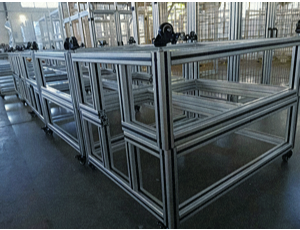
How to choose 4040 aluminum profiles that are more suitable for equipment frames? The key is never just the cross-sectional dimensions. What truly affects the end result is often the load-bearing margin, structural stability, connection method, machining accuracy, and convenience of subsequent maintenance. For equipment projects, 4040 aluminum profiles are often a balance between strength and cost. Accurate selection directly affects frame rigidity, assembly efficiency, and the lifecycle cost of the complete machine.
First, clarify the role of 4040 aluminum profiles in equipment frames
4040 aluminum profiles are a commonly used specification among industrial aluminum profiles, with a 40×40 cross-section. They are commonly used for automation equipment frames, safety enclosures, tooling platforms, and small- and medium-sized conveying equipment. Their frequent use is not because they are “universal,” but because their application boundaries are relatively clear.
Simply put, 4040 aluminum profiles are suitable for equipment frames with moderate load requirements and high demands for structural modularity. Compared with lightweight specifications such as 2020 and 3030, they offer more stable bending and torsional resistance. Compared with larger specifications such as 4080 and 8080, they provide better weight control and more manageable costs.
In other words, if the equipment requires a certain level of rigidity without making the complete machine excessively heavy, 4040 aluminum profiles will usually be among the preferred options for evaluation.
Why equipment frame selection is increasingly focused on 4040 aluminum profiles
Many equipment projects now move quickly, with frequent structural modifications and continuously compressed delivery schedules. Although traditional welded frames offer high strength, rework costs, surface treatment, transportation, installation, and on-site adjustments are all more complex. The advantage of industrial aluminum profile frames lies in their modularity and reconfigurability.
Against this background, 4040 aluminum profiles have become a frequent choice. They can meet the stability requirements of most medium-sized equipment frames while also being easy to combine with corner brackets, internal connectors, T-nuts, casters, sealing panels, and protective components for standardized assembly.
In actual operations, equipment manufacturers are increasingly focusing on three aspects: structural reusability, machining coordination efficiency, and supply stability. When 4040 aluminum profiles are well matched with the accessory system and machining services, they can often reduce the losses caused by repeated drawing revisions.
To determine suitability, first review these core parameters
When selecting 4040 aluminum profiles, do not rush to confirm the weight per meter or unit price. A more reliable approach is to evaluate the equipment frame from four dimensions: load-bearing, connections, machining, and assembly.
If these four aspects can be clearly confirmed during the solution stage, the suitability of 4040 aluminum profiles can usually be assessed with relatively good accuracy.
Which equipment frame applications are more suitable for 4040 aluminum profiles
4040 aluminum profiles are not suitable for every type of equipment, but they often offer better cost performance in the following applications.
- Main frames for small- and medium-sized automation equipment that need to balance strength and lightweight construction.
- Frames for equipment safety enclosures that require the installation of transparent panels, sealing panels, door locks, and sealing components.
- Support structures for conveying lines, with an emphasis on standardized assembly and subsequent expansion.
- Worktables, inspection tables, and fixture platforms that emphasize maintainability and multi-station combinations.
- Modular equipment requiring reserved space for cable channels, air tubing, and sensor brackets.
If the equipment involves large-span cantilevers, heavy mechanical impact, or high-frequency vibration, using 4040 aluminum profiles alone may not provide sufficient stability. In such cases, solutions using 4080, 6060, or even higher cross-section grades should be evaluated.
Do not overlook combining them with larger profile specifications
In actual projects, using a single specification is not necessarily the optimal solution. Higher-grade profiles can be selected for the base, main columns, and heavy-load crossbeams, while 4040 aluminum profiles can be used for door frames, accessory supports, and side enclosures. This better balances cost and strength.
For example, for certain high-rigidity chassis, the design concept of larger cross-section products such as XD-8-8080 can be considered, with zoned combinations using 4040 aluminum profiles. This ensures the stability of key areas without causing excessive design of the entire frame.
In addition to the profile itself, check whether the supporting system is complete
Many problems in later project stages are not caused by the 4040 aluminum profile itself, but by inadequate accessory systems and machining coordination. Even if the profile cross-section is selected correctly, inconsistent connection components, slot standards, cutting accuracy, or tapping depth can still slow down on-site assembly.
More importantly, an equipment frame is not a single-material purchase, but a complete structural solution. Corner brackets, bolts, nuts, connectors, casters, sealing strips, door hinges, and panel installation methods all need to be matched in advance.
Shanghai Xiangda Industrial Aluminum Profile Co., Ltd. has long provided industrial aluminum profile services for applications such as equipment frames, safety enclosures, conveying lines, and worktables. Its services cover mainstream specifications including 4040, together with cutting, drilling, tapping, CNC machining, and frame assembly. For projects requiring shorter delivery times, this one-stop coordination capability is often more valuable for reference than simply comparing profile unit prices.
During actual evaluation, common misconceptions deserve more attention than parameters
When selecting 4040 aluminum profiles for equipment frames, the most common misconceptions fall into three categories.
- Comparing only material prices without calculating assembly labor hours and subsequent adjustment costs.
- Selecting profiles solely based on experience without considering the equipment's moving components and eccentric-load conditions.
- Looking only at the cross-section specification without considering national-standard, European-standard, and accessory compatibility.
Another situation is also common: 4040 aluminum profiles are selected at the drawing stage, but during on-site assembly it is discovered that the door opening space is insufficient, the sensor bracket position interferes with other components, or the panel fixing method is unreasonable. The problems are not complicated, but the cost of rework can be significant.
Therefore, when determining whether 4040 aluminum profiles are suitable, it is best to include the equipment's overall dimensions, workstation layout, maintenance space, and accessory arrangement in the review, rather than treating the profiles as an independent material and making a separate decision.
Turn profile selection into an actionable evaluation process
To improve evaluation efficiency, the process can be carried out in the following order.
- First confirm the length, width, height, maximum load, and operating conditions of the equipment frame.
- Then distinguish the main load-bearing areas from auxiliary areas to avoid using the same specification throughout the entire structure.
- At the same time, verify the connection component system, slot standards, and panel installation method.
- Consider cutting, tapping, and hole-machining capabilities to reduce secondary processing on site.
- Finally, evaluate the delivery time, batch consistency, and room for future expansion.
When all these conditions are incorporated into the same evaluation process, whether 4040 aluminum profiles are suitable for equipment frames is no longer a vague judgment. Instead, it becomes a structural selection that can be verified, compared, and implemented.
For projects currently in progress, the more practical next step is to organize the frame load conditions, connection methods, machining list, and accessory requirements into a complete review checklist, and then compare solution combinations using different specifications. The 4040 aluminum profile solution selected in this way will be closer to the actual operating conditions of the equipment and will also facilitate subsequent procurement, assembly, and maintenance.
Related News
- ▶ Why Do Custom Aluminum Extrusion Die-Opening Prices Vary So Widely? What Are the Key Factors Affecting the Quote?
- ▶ Where to Buy Industrial Aluminum Profiles from a Reliable Supplier
- ▶ What Products and Projects Are Suitable for Custom Aluminum Profile Processing? An Overview of Common Industry Applications
Leave a Message Online

Thank you very much for writing to us. Please leave your message and contact information, we will reply to you within 24 hours.