
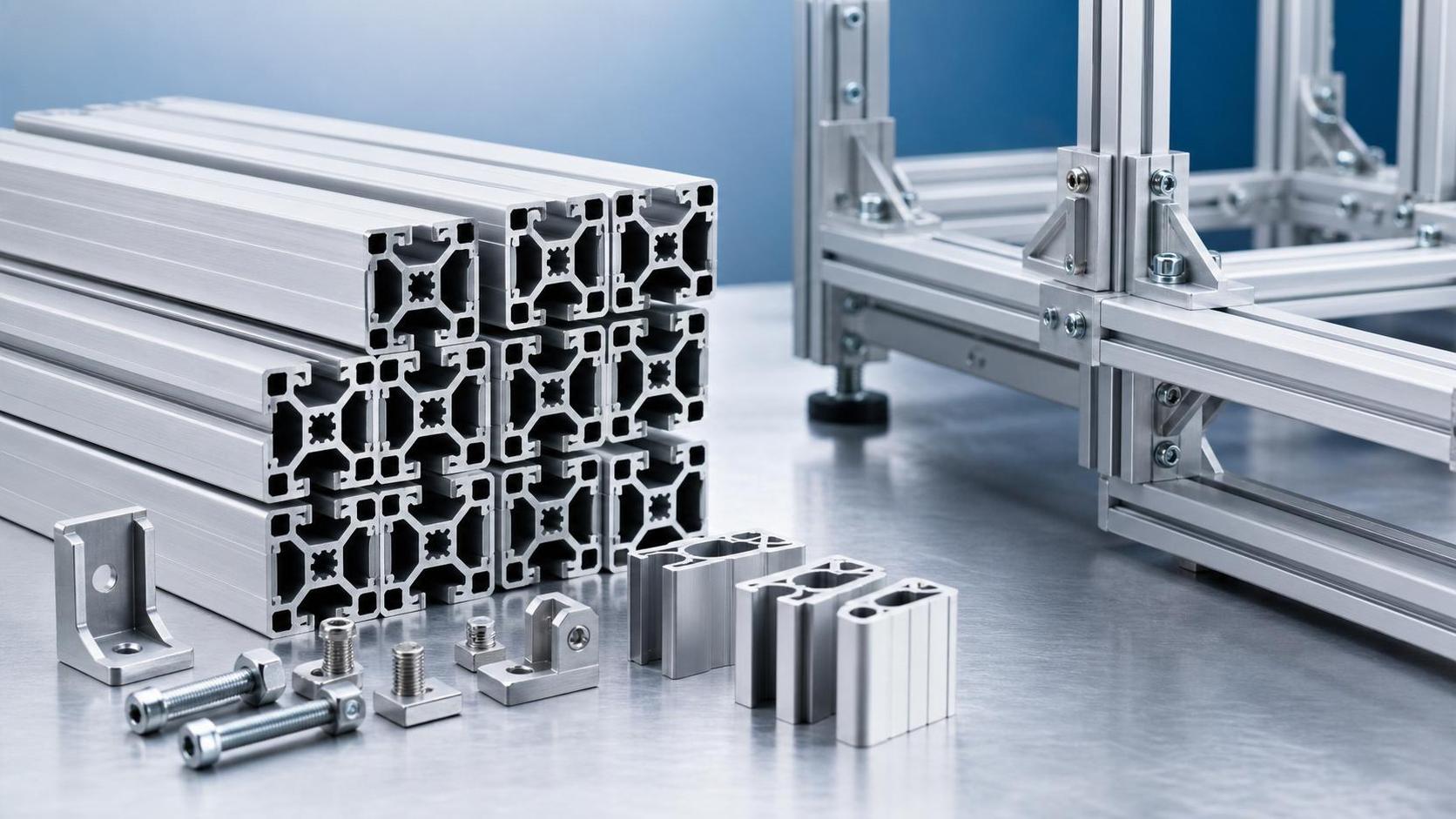
Three Common Pitfalls to Avoid Before Purchasing 4040 Aluminum Profile
When purchasing 4040 aluminum profile, many people first look at the unit price and then the specification table. Everything seems fine on the surface, but in reality they can easily miss key judgments.
What really affects project cost is often not the quotation itself, but whether load-bearing, processing, and delivery are aligned with actual site requirements.
If the early judgment is off, backwork, delays, material补充, and even a complete structural redo may follow, and the overall cost will instead be higher.
The three common pitfalls below are exactly the ones most easily overlooked in 4040 aluminum profile purchasing, yet most likely to drive up total cost.
Pitfall 1: Only Looking at the 4040 Aluminum Profile Price, Not the Real Load-Bearing Requirement
4040 aluminum profile is often used for equipment frames, workbenches, safety guards, and conveyor supports, so many buyers naturally assume it is “good enough.”
But even with the same 4040 aluminum profile, different groove types, wall thicknesses, cross-section designs, and material conditions result in different load-bearing performance.
If you only look at whether the quotation is low and ignore static load, dynamic load, and span conditions, purchasing risks often only become apparent after installation.
For example, after equipment is fitted with modules, cylinders, motors, or guards, structural weight increases, the beam deflection exceeds the limit, and overall rigidity becomes poor.
The few hundred yuan saved upfront may very likely be offset many times over later through reinforcement parts, rework labor, and downtime losses.
A More Reliable Way to Judge
- First confirm the application scenario: is it static support, or frequent start-stop and vibration?
- Clearly define the span, load distribution, connection method, and installation direction.
- Ask the supplier to provide cross-section parameters, moment of inertia, or load-bearing recommendations.
- When necessary, compare the overall cost of 4040 with 4080, 6060, and other specifications.
In real business, choosing the right 4040 aluminum profile is not about blindly choosing the thickest one; the key is balancing strength, weight, budget, and assembly efficiency.
Pitfall 2: Only Looking at the 4040 Aluminum Profile Specification, Not Processing Accuracy and Assembly Tolerance
Many purchase forms list the 4040 aluminum profile, length, and quantity, which seems to mean the information is complete, but this is only confirmation at the raw material level.
What really affects assembly efficiency is cutting accuracy, end-face perpendicularity, hole positions, screw quality, and accessory fit.
If these details are not controlled properly, the most common problems during on-site assembly are hole-position deviation, frames not fitting, loose connections, and rework.
Especially for automated equipment frames, the requirements for parallelism and perpendicularity are higher; compliant raw material specs do not mean the final assembly result will be qualified.
From a purchasing perspective, the most troublesome part is that these issues may not be directly reflected on the quotation, but they will definitely show up at the delivery stage.
Content That Should Be Focused on During Purchasing
- What tolerance range is the cutting accuracy controlled to.
- Whether drilling and tapping are processed according to the drawing, and whether there is an inspection process.
- Whether matching corner brackets, bolts, and nuts fit the groove of the 4040 aluminum profile.
- Whether pre-assembly, coding, packaging, and on-site installation logistics are supported.
If a project uses 4040 aluminum profile together with other cross-sections, it is even more important to confirm whether the overall connection solution is unified.
For example, some support positions may be more suitable for using XD-6-2060 cross-section as an auxiliary structure, reducing waste of the main frame material.
This combined approach is more economical than simply pursuing one specification throughout, and it also better fits the modular application logic of industrial aluminum profiles.
Pitfall 3: Only Confirming Supply, Not Evaluating Supply Stability and Coordination Capability
Another common blind spot in 4040 aluminum profile purchasing is to understand “having stock” as “being able to deliver stably.”
For sample orders, this issue is not obvious; once it enters bulk delivery or urgent replenishment stages, the gap becomes very large.
If the supplier only has basic inventory and lacks processing, accessories, assembly, and rapid response capabilities, then the purchasing cycle is very hard to truly shorten.
A more obvious signal is whether the other party can quickly follow up when the project changes drawings, adds connectors, or adjusts lengths.
Many delays are not because 4040 aluminum profile itself is hard to buy, but because the coordination chain breaks down in deep processing and delivery organization.
Several Dimensions of Stable Supply
- Whether it has one-stop capabilities for profiles, accessories, processing, and assembly.
- Whether it supports small-batch samples and subsequent bulk replication.
- Whether it can handle non-standard development, urgent lead times, and change orders.
- Whether it has a stable quality system and traceable process.
These points determine not only whether a single 4040 aluminum profile quotation is good, but also the efficiency of subsequent cooperation and the real purchasing cost.
Shanghai Xiangda Industrial Aluminum Profile Co., Ltd. focuses on equipment frames, safety guards, conveyor lines, workbenches, and other applications, and can provide one-stop support from extrusion to processing and assembly. This service capability is critical for project delivery.
When Purchasing 4040 Aluminum Profile, It Is Recommended to Turn the Evaluation Sheet into These 4 Items
If you want 4040 aluminum profile purchasing to be more stable, do not keep only the three columns of “price, quantity, and delivery time.”
A more practical approach is to shift the evaluation focus forward and screen out key risks at the inquiry stage.
The benefit is very direct: 4040 aluminum profile purchasing is no longer just a round of price comparison, but a more complete cost judgment.
When the evaluation dimensions are clearer, the follow-up quotation, delivery confirmation, and supplier screening will also be more efficient.
Conclusion: In 4040 Aluminum Profile Purchasing, Don’t Mistake a Low Price for Low Cost
Back in the purchasing field, what really needs to be avoided with 4040 aluminum profile is not a certain profile model, but an overly single decision-making method.
Looking only at price may ignore load-bearing risk; looking only at specification may ignore processing errors; looking only at whether goods can be shipped may ignore supply stability.
Once 4040 aluminum profile purchasing enters an equipment manufacturing scenario, any small deviation will eventually show up in the lead time and total cost.
Therefore, what is more worth paying attention to is whether the supplier can bring profiles, accessories, processing, and delivery into coordination to form a stable solution.
Before the next inquiry, first list the load conditions, processing requirements, and delivery milestones clearly, and then compare the 4040 aluminum profile solutions. The judgment will be more stable and closer to the real cost.
Related News
- ▶ Moving Forward Together, Achieving Shared Success | On October 10, Shanghai Xiangda Industrial Aluminum Profiles welcomed customers and partners for a visit and inspection
- ▶ Why Do Custom Aluminum Extrusion Die-Opening Prices Vary So Widely? What Are the Key Factors Affecting the Quote?
- ▶ How to Choose Between 6063 and 6061 Alloys for Custom Aluminum Extrusion Dies?
Leave a Message Online

Thank you very much for writing to us. Please leave your message and contact information, we will reply to you within 24 hours.