
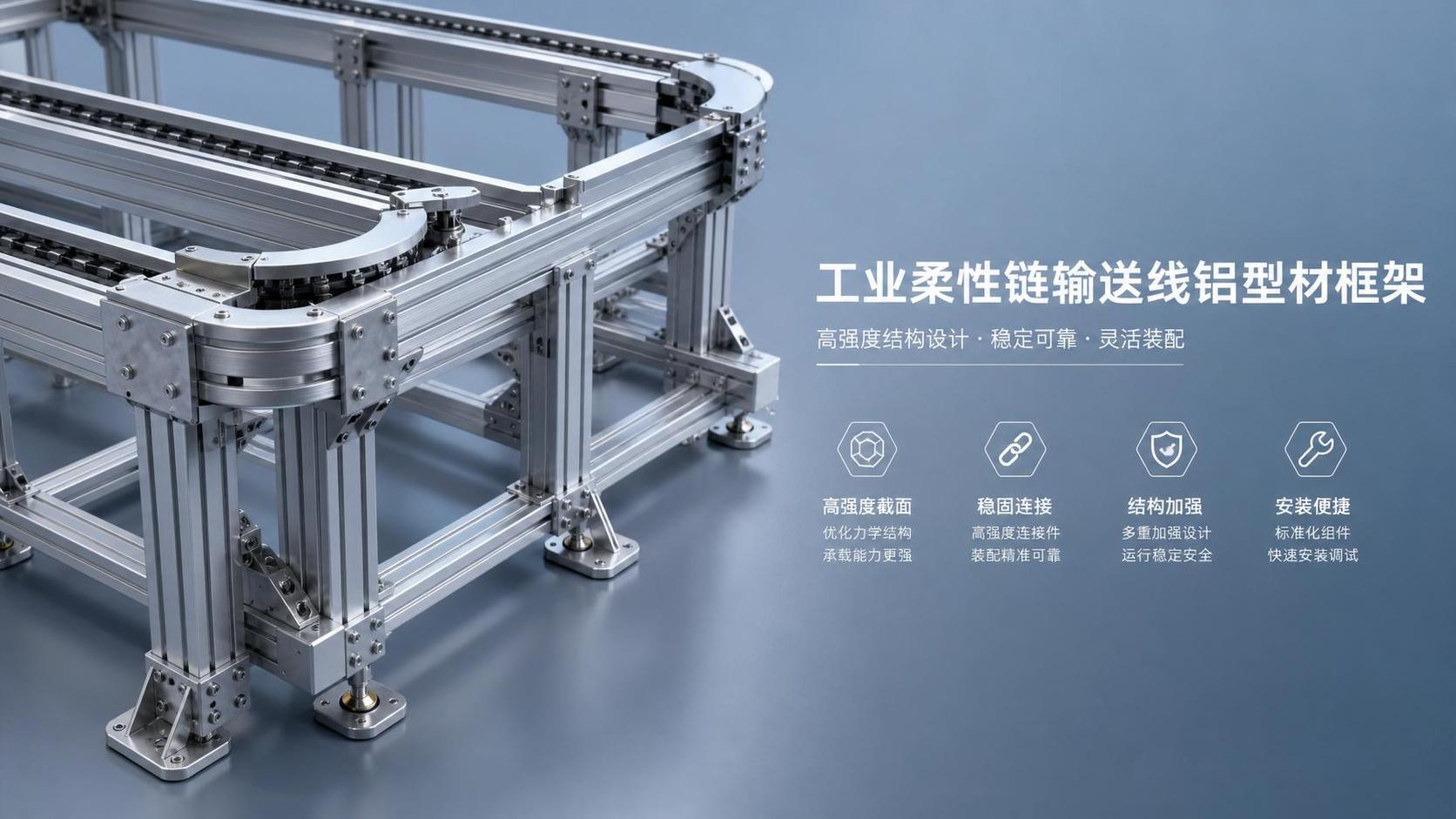
Why Flexible Chain Aluminum Profiles Are Often Used in Automated Conveyors
In automated production line planning, the conveying system is often not a standalone piece of equipment, but an important link connecting material feeding, assembly, inspection, and packaging. Flexible chain aluminum profiles are frequently adopted because their core advantage lies in combining “conveying efficiency” and “layout flexibility” in one solution.
Compared with traditional rigid conveying structures, flexible chain aluminum profiles are more suitable for production lines with limited space, multiple workstations, and complex routes. Their adaptability is especially evident at turns, slopes, diverging, and converging sections. This also means easier implementation in the early planning stage and more controllable costs for later line changes.
From recent project needs, companies are placing higher requirements on line flexibility, pulse stability, and maintenance convenience. Flexible chain aluminum profiles are not only about “being able to convey”; more importantly, they can work with automation equipment, robotic units, safety guards, and workstation systems to form a complete scenario-based layout solution.
Which Typical Conveying Scenarios Are Flexible Chain Aluminum Profiles Suitable For
If you only look at a single transfer requirement, many conveying methods can complete the task. But in actual operations, what truly affects the advantages of a solution are on-site space, product characteristics, pulse requirements, and the difficulty of later expansion. Flexible chain aluminum profiles are usually more suitable for the following scenarios.
Turning Conveying Scenarios
Production lines such as electronic assembly, daily chemical packaging, food outer packaging, and medical component transfer often need to route around equipment, columns, or passages. Flexible chain aluminum profiles can realize horizontal turning conveying, making logistics paths more compact without adding excessively long straight sections just to avoid obstacles.
The value of this type of scenario is very direct: it saves floor space, reduces idle running, and improves workstation docking efficiency. For old factory renovation projects, this is especially critical.
Slope and High-Low Transition Scenarios
When materials need to move from a manual loading area into an equipment inlet, or from an inspection station into a packaging station, height differences often occur. Flexible chain aluminum profiles are suitable for stable uphill and downhill transitions of light to medium-load products, keeping the conveying path continuous and making pulse control easier.
For bottle, plastic shell, small box, and tray-type products, as long as the focus and bottom stability are maintained, flexible chain conveying can usually balance speed and smoothness.
Cleanroom and Light-Load Conveying Scenarios
In cleanrooms for medical devices, electronic components, and new energy auxiliary materials, the focus is not only on conveying efficiency, but also on structural cleanliness, easy maintenance, and clean management. Flexible chain aluminum profiles have neat surfaces and a high degree of modularization, making them suitable for production environments with relatively high on-site order requirements.
At the same time, they have high compatibility with protective covers, guardrails, supports, and workbenches in aluminum profile systems, which makes overall line design more convenient.
Multi-Station Assembly and Buffer Conveying Scenarios
Multi-station assembly lines are very sensitive to inconsistent front and rear pulse rhythms. Flexible chain aluminum profiles can be used together with stops, guides, buffer sections, and transfer tables to help achieve pulse buffering and inter-station transfer, avoiding local congestion.
For projects that may add workstations later, the expansion advantage of flexible chain aluminum profiles is more obvious than welded structures.
How to Use Flexible Chain Aluminum Profiles More Reasonably in Production Line Layout
Many projects are not failing because the conveyor was chosen incorrectly, but because the layout method is unreasonable, leading to frequent adjustments later. To make flexible chain aluminum profiles truly effective, the key is not only the profile itself, but the logic of the entire line planning.
First Look at the Logistics Path, Then Determine Equipment Positions
It is recommended to first sort out product flow, pulse points, manual operation areas, and inspection/repair passages, and then determine the route of the flexible chain aluminum profiles. Doing so can reduce the problem of “the equipment is fixed, but the conveyor cannot get around it” later.
Evaluate Bend Radius and Pulse Together
Flexible chain aluminum profiles are suitable for bends, but not the more the better. If the bend radius is too small, or the speed setting is too high, it may affect product posture stability. This requires advance verification, especially for long and slender parts, lightweight packaging, and products with uneven bottoms.
Reserve Expansion Sections and Interface Positions
Many production line renovation cycles are getting shorter. When laying out flexible chain aluminum profiles, it is advisable to reserve power interfaces, support installation positions, and future connection sections. This way, if inspection equipment, labelers, or buffer sections are added later, there is no need for major dismantling or reconstruction.
Integrate the Aluminum Profile Framework with the System Design
If the conveyor line is surrounded by protective covers, equipment supports, light racks, viewing frame racks, or workbenches, it is best to adopt a unified industrial aluminum profile system. This will provide advantages in installation precision, on-site appearance, maintenance convenience, and parts interchangeability.
What Key Points Should Be Considered When Selecting Flexible Chain Aluminum Profiles
Whether a flexible chain aluminum profile solution is good or not cannot be judged by price alone; it also depends on whether it fits the product, the space, and the operating goals. The following points usually determine whether later operation will be stable.
- Product dimensions and bottom condition: the more stable the bottom, the smoother the conveying.
- Single-piece weight and pulse requirements: these relate to chain plate, drive, and support structure configuration.
- Route complexity: the more turns, slopes, and divergences, the more the overall matching needs to be emphasized.
- On-site environment: cleanliness, moisture resistance, corrosion resistance, or noise requirements will all affect the solution.
- Expected future expansion: determine whether modular redundant design is needed.
More practically speaking, flexible chain aluminum profiles are suitable for “continuous conveying of light to medium loads in multi-scenario settings.” If the product is too heavy, impact is too large, or extremely high rigidity support is required, other conveying structures should be considered comprehensively rather than forcing a fit.
How Common Application Solutions Are Implemented
To facilitate project progress, the application solution for flexible chain aluminum profiles can be broken down into clearer implementation steps. In this way, efficiency will be much higher from communication to drawings, and then to installation and delivery.
- Confirm product parameters, including dimensions, weight, bottom surface, and conveying posture.
- Sort out the process flow and clearly define feeding, assembly, inspection, and packaging points.
- Measure the on-site space and mark columns, door openings, passages, and repair areas.
- Determine the route of the flexible chain aluminum profile and evaluate turning and high-low difference solutions.
- Unify the matching of supports, guards, guides, and peripheral frame structures.
- Verify pulse, stability, and maintenance convenience during the trial run stage.
The advantage of this method is that problems are exposed early. Once the equipment is installed on site, the cost of rework is usually much higher.
Risks That Are Easy to Overlook When Using Flexible Chain Aluminum Profiles
Many on-site problems are not caused by the material itself, but by unclear selection boundaries. When using flexible chain aluminum profiles, the following risks should be avoided in advance.
- Only focusing on current capacity, while ignoring future expansion needs, which makes renovation difficult.
- Only looking at a single conveyor section, while ignoring the pulse of the whole line, resulting in local congestion.
- Ignoring product posture changes, causing deviation or tilting after turns.
- Choosing a support structure that is too light, leading to reduced stability after long-term operation.
- Lack of a unified interface between the conveyor line, protective cover, and equipment base.
These problems may seem minor, but once mass production begins, they directly affect uptime and maintenance costs. Therefore, the flexible chain aluminum profile solution should not only be considered from the perspective of a single machine, but from the perspective of the entire line.
How to Choose a More Reliable Supporting Service Solution
For production line projects requiring long-term operation, flexible chain aluminum profiles are not just a procurement item, but a reflection of delivery service capability. Whether the supplier has the ability to coordinate profiles, accessories, deep processing, assembly, and delivery often directly affects project progress.
Shanghai Xiangda Industrial Aluminum Profile Co., Ltd. has long focused on industrial aluminum profiles and scenario-based solutions, and can meet the needs of equipment frames, safety guards, conveyor lines, workbenches, and more. It provides a one-stop supporting service covering national standard and European standard industrial aluminum profiles, accessories selection and matching, cutting and punching, tapping, CNC machining, and frame assembly.
From the perspective of flexible chain aluminum profile applications, this integrated capability is very practical. Communication in the early stage is smoother, non-standard interfaces are easier to handle, and the delivery cycle is easier to compress. This is especially important for projects that require sampling, small-batch verification, or urgent supply.
Conclusion: Understand the Scenario First, Then Discuss the Flexible Chain Aluminum Profile Solution
Flexible chain aluminum profiles are suitable for turning conveying, slope transitions, cleanrooms, multi-station assembly, and renovated production lines. Their advantages lie in flexible layout, convenient expansion, and high system compatibility. But whether they are truly suitable still depends on product characteristics, pulse goals, and on-site space.
If you want the conveyor line to meet current capacity while leaving room for future upgrades, it is recommended to incorporate flexible chain aluminum profiles into the overall line planning at the beginning of the project, and evaluate the support frame, guard system, and processing/delivery capability at the same time. Doing this upfront work well will make line implementation more stable and later adjustments easier.
Related News
- ▶ Moving Forward Together, Achieving Shared Success | On October 10, Shanghai Xiangda Industrial Aluminum Profiles welcomed customers and partners for a visit and inspection
- ▶ Why Do Custom Aluminum Extrusion Die-Opening Prices Vary So Widely? What Are the Key Factors Affecting the Quote?
- ▶ How to Choose Between 6063 and 6061 Alloys for Custom Aluminum Extrusion Dies?
Leave a Message Online

Thank you very much for writing to us. Please leave your message and contact information, we will reply to you within 24 hours.