
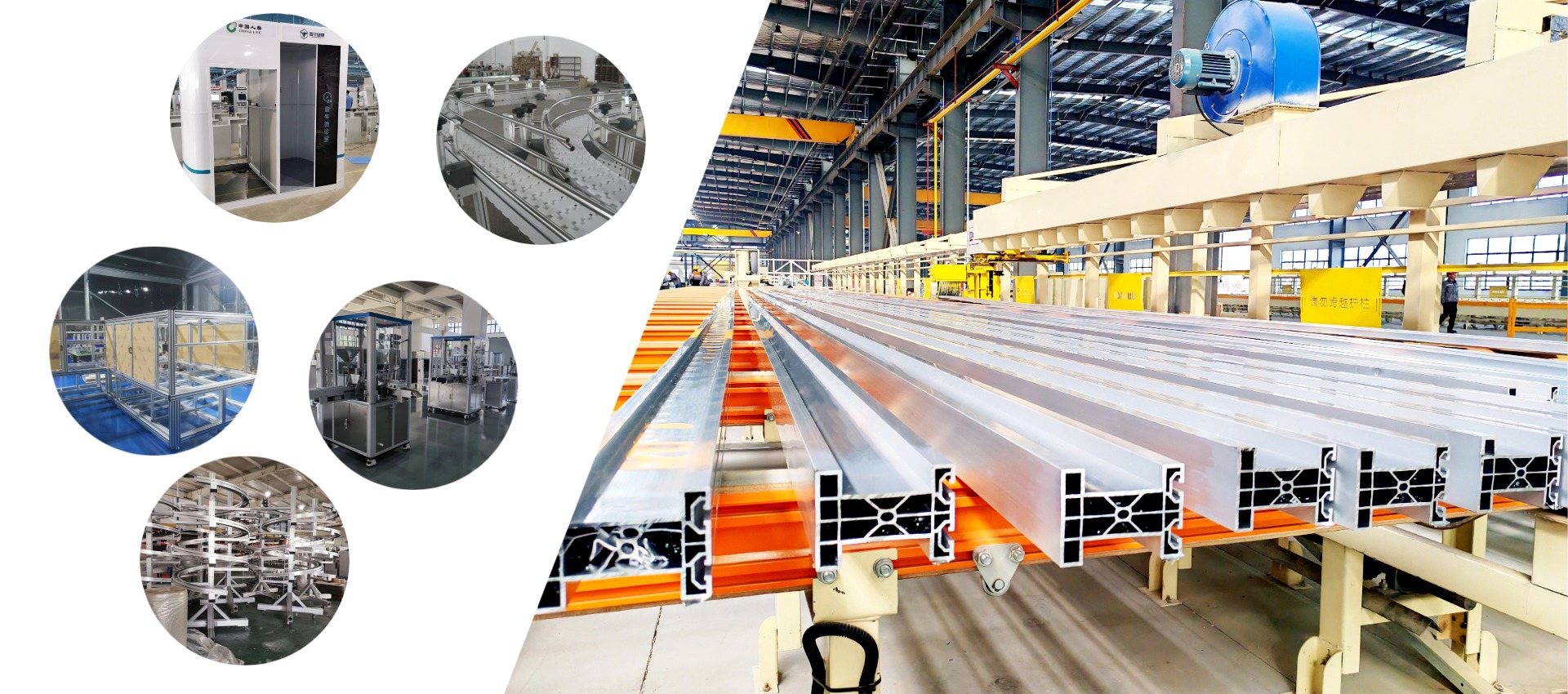
Custom Aluminum Profile Processing Is Usually About Project Implementation, Not the Material Itself
The suitability of custom aluminum profile processing for a product project depends not simply on whether aluminum profiles can be used, but on whether they are used appropriately. Even with the same industrial aluminum profiles, the evaluation criteria differ when they are used for equipment frames, safety guards, conveyor lines, or workbenches. Structural strength, assembly efficiency, room for future modifications, the operating environment, and delivery schedule all affect the final solution.
In actual projects, many requirements may initially appear similar, but the differences often become more pronounced once design and installation begin. The value of custom aluminum profile processing lies in transforming standard aluminum profiles into structural solutions that better suit the application through cutting, drilling, tapping, CNC machining, and assembly support, thereby reducing rework and secondary modifications.
Shanghai Xiangda Industrial Aluminum Profile Co., Ltd. has long served the automation, equipment manufacturing, warehousing and logistics, new energy, and medical equipment sectors. Leveraging its location in Shanghai's Songjiang District and an established supply chain, the company combines mainstream national-standard and European-standard specifications with deep processing, accessories, and assembly services. For projects with tight delivery schedules, multiple specifications, and frequent changes, this one-stop support makes schedule control easier.
Assess the Application Scenario First to Determine Whether Custom Aluminum Profile Processing Is Necessary
For simple brackets or light-load partitions, standard profiles and conventional connectors are often sufficient. However, when a project involves equipment integration, functional openings, non-standard connections, limited installation space, or provisions for future expansion, the need for custom aluminum profile processing increases significantly.
A more common approach is to ask three questions first: Does the structure require repeated assembly? Is the site likely to change? Do the components need to work together with electrical systems, panels, guards, casters, or doors? If at least two answers indicate complexity, custom processing is usually more reliable than simply purchasing standard materials.
For Equipment Frame Projects, the Focus Is Not Only on Load-Bearing Capacity, but Also on Assembly and Expandability
Equipment frames are one of the most common applications for custom aluminum profile processing, particularly in automation equipment, inspection equipment, and smart manufacturing units. Such projects generally require not only structural stability, but also accurate mounting hole positions, convenient accessory installation, and reserved space for cable channels, panels, and future additions.
For example, 4040, 4080, and 6060 profiles are commonly used for medium- and large-sized frames. However, whether reinforcing ribs, a thickened base, or a change to internal connections is required must be determined according to the equipment's center of gravity, vibration frequency, and handling method. Selecting profiles based only on cross-sectional size can easily result in insufficient rigidity or an overly heavy structure, which may instead increase costs and reduce assembly efficiency.
For projects requiring partial slot covering, cable routing organization, or improved overall appearance, accessories such as XD-8-4040EA single-sided slot cover may also be used. It is not necessary for every frame, but on equipment where neatness and ease of maintenance are important, it can often reduce exposed cables and dust accumulation.
Safety Guards and Fences Require Greater Attention to Detail and Compatibility
Guard projects may appear structurally simple, but they place high demands on the details of custom aluminum profile processing. The direction in which doors open, the size of viewing windows, the panel material, the position of locks, and the equipment maintenance area all affect the profile cross-section and connection method. Particularly around automated production lines, the protective structure must meet safety requirements without interfering with operation and maintenance.
These applications usually place greater emphasis on installation tolerance control. If the site foundation is not completely level or the equipment has irregular boundaries, preparing the cutting, drilling, and assembly plan in advance is more reliable than making temporary modifications on site. For protective structures that combine transparent panels, sheet-metal panels, and mesh panels, deep-processing accuracy directly affects door gaps, corners, and the overall appearance.
Conveyor Lines and Logistics Workstations Are More Sensitive to Cycle Time and Maintenance
When custom aluminum profile processing is used for conveyor line projects, the structure should not be regarded merely as a “support frame.” The core of conveyor equipment is continuous operation, so the structural solution must withstand dynamic loads while also coordinating the installation of motors, rollers, guides, guardrails, and sensors. Deviations in hole positions, uneven support feet, or inconsistent connectors may subsequently cause belt deviation and maintenance difficulties.
In warehousing, logistics, and production-line transfer applications, the common requirement is often not a single piece of equipment, but the modular replication of an entire conveyor section. In this case, the focus of custom aluminum profile processing shifts from the accuracy of individual parts to consistency across batches. Many projects in the Yangtze River Delta have tight cycle times and often require rapid volume production after small-batch trial assembly. In such cases, one-stop processing and assembly support can better shorten delivery times.
Workbenches, Tooling Racks, and Peripheral Fixtures Often Place Greater Emphasis on Ergonomics and Modification Space
Workbench projects are often underestimated. Although their loads may not always be the highest, unreasonable dimensions, shelf heights, casters, tabletop materials, or accessory layouts can easily result in a poor user experience. The value of custom aluminum profile processing in this area lies in integrating drawers, lighting, sockets, tool panels, material bins, and electrostatic-control requirements into one consistent structural design.
Electronic equipment assembly, medical equipment assembly, and inspection workstations have more specific requirements for cleanliness and maintenance routes. Compared with one-time welded structures, industrial aluminum profiles are better suited to subsequent height adjustments, accessory additions, and workstation reconfiguration. Site requirements involve more than whether the dimensions are suitable; personnel positioning, material flow, and the convenience of equipment interfaces must also be considered.
For New Energy and Non-Standard Equipment Projects, Differences Often Lie in Whether the Processing Chain Is Complete
Photovoltaic equipment, lithium battery equipment, and various types of non-standard equipment place comprehensive demands on custom aluminum profile processing. Projects may involve not only standard cross-section selection, but also non-standard profile development, special length control, surface treatment requirements, and assembly accuracy management. If the supplier can provide only raw materials but cannot undertake subsequent deep processing and assembly, project coordination costs will increase significantly.
These applications are generally better suited to cooperation with an established manufacturer capable of mold design, profile extrusion, precision processing, and assembly. The reason is straightforward: many problems arise not from the design drawings, but from gaps between manufacturing processes. A feasible drawing does not necessarily mean smooth batch assembly, especially when a project also involves urgent deliveries and changes across multiple batches. Responsiveness is more important than simply offering a low price.
Comparing the Key Evaluation Criteria for Different Projects Makes the Differences Clearer
To quickly determine whether custom aluminum profile processing is suitable, compare the characteristics of the project first rather than directly applying a commonly used solution.
Misjudgments Before Implementation Often Affect Results More Than Profile Selection Itself
Many projects focus only on aluminum profile specifications and unit prices during the early stage, while overlooking connection methods, accessory compatibility, and space for subsequent maintenance. Although material costs may appear lower, the time and labor costs may later be incurred again through secondary drilling, installation rework, and inconvenient replacement.
- Treating static brackets and dynamic equipment frames as the same type of requirement.
- Looking only at cross-sectional dimensions without calculating connection strength and changes in the center of gravity.
- Ignoring the site environment, such as dust, humidity, cleaning frequency, and protection requirements.
- Considering only current installation without reserving routes for expansion, maintenance, and replacement.
- Dividing processing among too many subcontractors, making it difficult to unify dimensional responsibility.
In actual applications, these problems do not usually become apparent immediately. They tend to emerge together during trial assembly, commissioning, and subsequent maintenance. Therefore, determining whether custom aluminum profile processing is suitable for a project requires more than checking whether the drawings can be produced; it is also necessary to assess whether the structure can be installed smoothly, modified when needed, and maintained effectively on site.
A More Reliable Approach Is to Establish a Project Compatibility Checklist First
Before starting a project, five basic conditions can be reviewed first: load range, environmental requirements, installation space, maintenance frequency, and delivery schedule. Then match the profile specifications, accessory combinations, deep-processing requirements, and the need for frame assembly one by one. This makes many solution choices much clearer.
If the project involves replication across multiple batches, on-site adjustments, or appearance finishing requirements, the consistency of slot covers, cover plates, and standard accessories can also be considered at the same time. Accessories such as XD-8-4040EA single-sided slot cover are suitable for evaluation in the context of local organization and structural detail optimization, rather than being applied mechanically to every project.
From the perspective of actual implementation, custom aluminum profile processing is better suited to product projects with clear requirements for structural efficiency, delivery control, and subsequent maintenance. Clarifying differences between application scenarios first, then checking key parameters and implementation conditions, is often more valuable than simply comparing specifications. Evaluating usage requirements, processing depth, assembly method, and supplier responsiveness together can make the project solution more reliable and subsequent execution smoother.
Related News
- ▶ Why Do Custom Aluminum Extrusion Die-Opening Prices Vary So Widely? What Are the Key Factors Affecting the Quote?
- ▶ Where to Buy Industrial Aluminum Profiles from a Reliable Supplier
- ▶ What Products and Projects Are Suitable for Custom Aluminum Profile Processing? An Overview of Common Industry Applications
Leave a Message Online

Thank you very much for writing to us. Please leave your message and contact information, we will reply to you within 24 hours.