
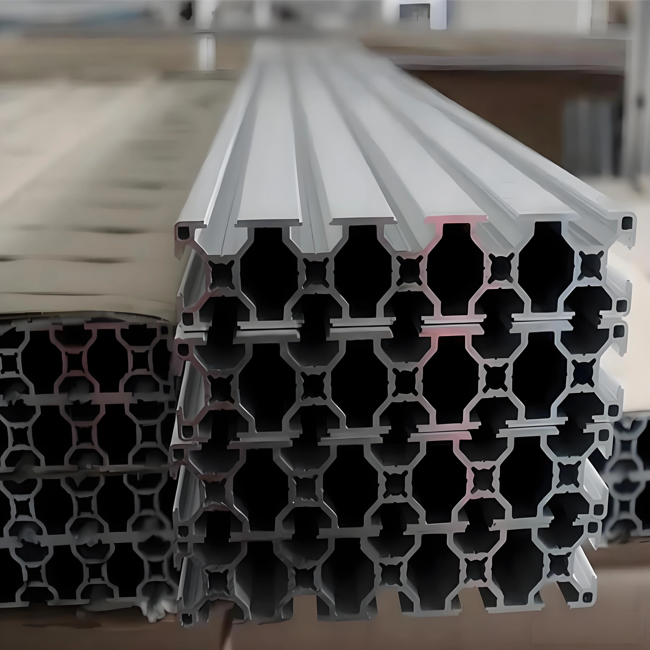
Composition and selection of the pickling solution for industrial aluminum profiles: The pickling solution for bright acid degreasing mainly consists of inorganic acids, oxidizers, high-priced metal ions, and surface activators for industrial aluminum profiles.
1. Selection of inorganic acids Inorganic acids can be sulfuric acid, nitric acid, phosphoric acid, metaphosphoric acid, ammonium sulfamate, hydrofluoric acid, etc.
(1)Sulfuric acid is relatively inexpensive and has weak corrosive ability on industrial aluminum profiles. It can wet and lubricate the entire substrate surface, dissolve the natural oxide film on industrial aluminum profiles, and loosen oil stains. The drawback is that the heat released by dilution is very high; when adding into water, it must be added slowly, otherwise it may cause the solution to splash and lead to an accident.
(2)Nitric acid: unstable, decomposes when exposed to light and heat, releasing nitrogen dioxide, which is highly toxic and harmful to the human body. Nitric acid has an irritating odor and is a strongly oxidizing acid. It can dissolve many impurities and remove scale from industrial aluminum profiles, and has passivation and brightening effects. Its price is higher than sulfuric acid.
(3)Phosphoric acid is a moderately strong acid. When mixed with other acids, it can buffer the solution, which is beneficial for adjusting and controlling the acidity and alkalinity of the cleaning solution. However, except for chloride, sodium, and aluminum salts, most phosphoric acid salts are difficult to dissolve in water, and phosphoric acid is much more expensive than nitric acid.
(4)Ammonium sulfamate is a colorless, odorless, crystalline inorganic acid with very low toxicity, also known as solid sulfuric acid. It is stable at room temperature, dissolves in water, and ionizes in water, belonging to a monobasic acid. Its characteristic is being a solid acid; its corrosiveness to industrial aluminum profiles is low, and most of its metal salts are soluble in water, so no new precipitation is produced. Ammonium sulfamate is relatively expensive.
(5)Hydrofluoric acid is volatile, has an irritating odor, is highly toxic, and has strong dissolving power on oxides such as alumina, but it is not as strong in dissolving aluminum as sodium hydroxide. It also has special dissolving ability for silica, and can be used in combination with sulfuric acid. It is also the main etching liquid for bright acid degreasing.
Based on the physical and chemical properties of the five inorganic acids above, the five acids can be selected as a combined pickling solution for A and C agents. Generally, sulfuric acid and hydrofluoric acid are used as the main components, accounting for about 90% of the pickling solution, while the other three inorganic acids play a synergistic auxiliary role, accounting for about 10% of the pickling solution.
2. Selection of oxidizers The brightening function of the oxidizer in bright acid degreasing can increase the brightness of the industrial aluminum profile surface. Generally, hydrogen peroxide or nitrate salts are selected. Both hydrogen peroxide and nitrate salts can anodize the surface of industrial aluminum profiles, forming a thin aluminum oxide film, which slows the dissolution rate at surface recesses and accelerates the dissolution rate at protrusions; in effect, it is a leveling and brightening process.
3. Selection of high-priced metal ions High-priced metal ions are generally Fe3⁶⁺, added in the form of salts such as sulfuric acid (high) iron and nitric acid iron. They can accelerate the corrosion of industrial aluminum profiles. Fe3⁶⁺ ions can undergo a displacement reaction on the surface of industrial aluminum profiles, forming micro-batteries, causing a tiny amount of hydrogen gas to be generated on the aluminum surface and carrying oil stains away from the surface of the industrial aluminum profile. At the same time, Fe3⁶⁺ can also inhibit the corrosion of stainless steel equipment by degreasing liquid.
4. Selection of surface activators for industrial aluminum profiles Surface activators for industrial aluminum profiles can improve the wetting property of the industrial aluminum profile surface and reduce the adhesion of oil stains, so that after emulsification, the oil stains are evenly dispersed into the degreasing solution. In acid degreasing solutions, acid-resistant nonionic or anionic surface activators, such as long-chain fatty alcohol polyoxyethylene ether, alkyl phenol polyoxyethylene ether, and alkyl dimethyl amine oxide, are preferred. Through experiments, the optimal ratio of the degreasing agent in the bright acid degreasing solution, that is, the surface activator, has been summarized as follows: fatty alcohol polyoxyethylene ether 12%, alkyl phenol polyoxyethylene ether 6%, dodecyl dimethyl amino oxide 12%, triethanolamine oleate 50%, water: balance.
5. Bright acid degreasing agent The “three-in-one” function of the bright acid degreasing agent greatly simplifies the process, enabling pretreatment to reach the anodizing step in one go. One disadvantage is that it cannot be used for sandblasting surface treatment, and the oil contamination must not be too severe. A long-term, short-term, optimized configuration process should be adopted for the final selection.
Related News
- ▶ Why Do Custom Aluminum Extrusion Die-Opening Prices Vary So Widely? What Are the Key Factors Affecting the Quote?
- ▶ Where to Buy Industrial Aluminum Profiles from a Reliable Supplier
- ▶ What Products and Projects Are Suitable for Custom Aluminum Profile Processing? An Overview of Common Industry Applications
Leave a Message Online

Thank you very much for writing to us. Please leave your message and contact information, we will reply to you within 24 hours.