
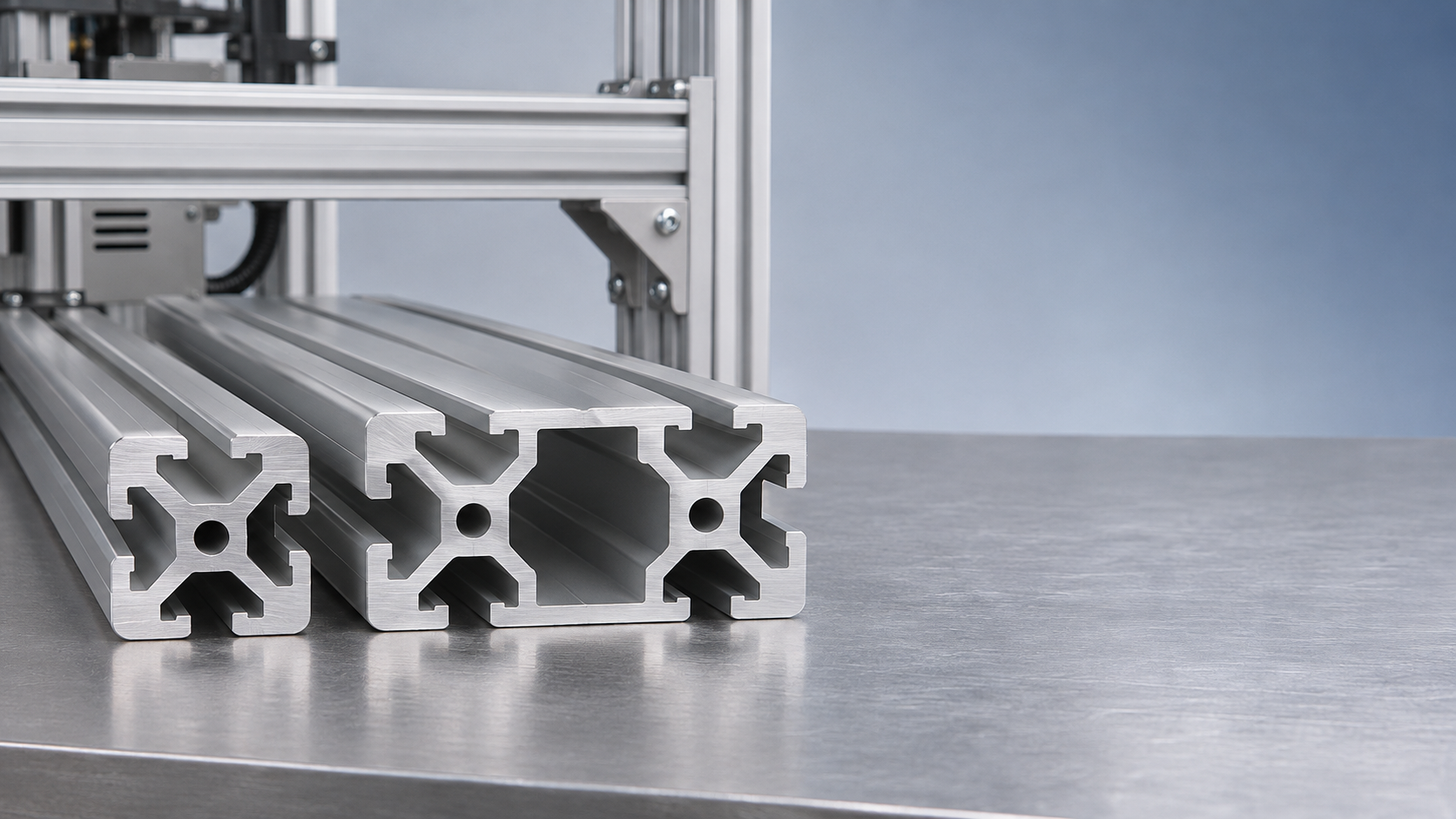
When building an equipment frame, seeing both 4040 and 4080 profiles on a quotation can leave many buyers unsure which to choose: they worry that 4040 may not make the frame stable enough, but that switching to 4080 may add more weight and cost than necessary. How should you choose between general-purpose 4040 and 4080 aluminum profiles for frames? The key is not to compare sizes alone, but to consider the actual load, direction of force, frame span, and budget together to avoid unnecessary costs from choosing the wrong profile.
4040 and 4080: the difference is more than a doubling of one cross-section dimension
A 4040 industrial aluminum profile generally has an approximate cross-sectional size of 40 mm × 40 mm, while a 4080 profile is approximately 40 mm × 80 mm. The former has a more symmetrical cross-section and is suitable for compact frames. The latter has a rectangular cross-section. Assuming a similar cross-section design, material, and installation method, using its 80 mm dimension in the primary bending direction generally helps increase the beam’s bending stiffness.
Note that a profile’s model dimensions do not indicate its specific load capacity. Even profiles of the same 4040 or 4080 size may differ in wall thickness, internal structure, slot type, and weight per unit length across different series. When a quotation lists “4040” or “4080,” also check the cross-section drawing and technical specifications rather than comparing profiles by their external dimensions alone.
The applications in the table are intended only as an initial guide. They do not mean that 4040 cannot be used as a main beam or that 4080 is sufficient for every heavy-duty application. The actual solution depends on how the load acts on each specific component.
Start with these four factors when choosing a profile
1. How large is the load, and where is it placed?
The effect on a frame differs when the weight of a machine is distributed evenly across several beams versus concentrated in the middle of a crossbeam. Before purchasing, distinguish between the equipment’s own weight, the weight of materials, and any additional loads that may arise during operation, and confirm the contact points and support locations. Factors such as motor start-up and shutdown, operator activity, and equipment vibration should also be considered under actual operating conditions.
If all you know is that “a machine will sit on the workbench,” but you do not know where its mounting feet are, it will be difficult for the supplier to make a reliable assessment. The equipment weight, mounting-hole locations, and operating conditions are more useful than the total weight alone.
2. The longer the span, the more important deflection becomes
As the effective span between the ends of a crossbeam increases, it may deflect enough to affect work surface flatness, door closure, or equipment positioning even if the profile does not show obvious damage. For equipment with stringent accuracy requirements, the question is not just whether it can bear the load, but also how much deflection is acceptable during operation.
If using 4040 for a long crossbeam, consider adding a center post, shortening the span, or adjusting the structure to distribute the load. If a passageway or installation space must remain clear in the middle, 4080 may be an option for the crossbeam. The specific solution should be calculated based on the load, support conditions, and allowable deflection rather than selected by applying a fixed span limit.
3. Do not overlook the installation orientation of 4080
The two cross-sectional dimensions of a 4080 crossbeam are different. For a crossbeam that mainly bears vertical loads, check whether it is positioned with the 80 mm dimension vertical. If the primary force acts laterally, reassess the choice based on the actual load direction. Rotating the profile during installation can affect its resistance to bending.
A sturdy profile does not necessarily mean that its connections are reliable. The specifications and quantity of angle brackets, bolts, and connecting plates, as well as the joint’s resistance to rotation, all affect the performance of the complete frame.
4. Consider the cost of the entire frame, not just the price per meter
4080 generally has a larger cross-section and uses more material, but the total cost also includes cutting, drilling, tapping, connection hardware, transportation, and assembly. Conversely, if using 4040 throughout requires many additional supports and connectors, the savings on profile material may be offset.
When comparing quotations, ask suppliers to itemize the materials and processing for each option based on the same drawing and connection requirements. Align the profile series, quantities, and included accessories to see which solution is more suitable.
How can you make an initial choice for a specific application?
Equipment safety enclosures: If the frame is mainly used to hold protective panels, doors, and viewing windows and is subject to relatively low external loads, consider starting with 4040. For enclosure door frames, also consider hinge locations, door size, and opening and closing frequency. If the door is large or other components need to be mounted above it, check the relevant components separately.
Workbenches: For general assembly or inspection work with a light load on the work surface, you can start by evaluating a 4040 solution. If the work surface will hold heavy equipment or needs a large unsupported working area, consider using 4080 for the main load-bearing crossbeams, then position the posts and secondary beams as needed.
Automation equipment frames: Equipment mounting surfaces may bear concentrated loads and may also have vibration and positioning requirements. In this case, do not choose profiles based solely on the overall frame size. Determine the main beam specifications based on equipment mounting points, operating conditions, and stiffness requirements. Other suitable profile sizes can be selected for support panels, cable ducts, and similar components according to the loads they bear.
Many frames do not need to use just one profile size throughout. Using 4080 for the main load-bearing beams and 4040 for protective panel supports or shorter auxiliary crossbeams is an option worth comparing. When mixing profile sizes, however, confirm in advance that the connection faces, slot types, and accessories are compatible to avoid having to modify holes during installation.
Confirm these details before placing your order
- Confirm the profile series: Request a cross-section drawing and check the external dimensions, slot type, wall thickness or weight per unit length, and surface finish requirements. Accessories for different series, such as national standard and European standard profiles, may not be interchangeable.
- Confirm the machining references: Specify the cut lengths, hole locations, tapping direction, and dimensional requirements. Clearly mark related assembly points on the drawing wherever possible.
- Confirm the joint design: Specify whether angle brackets, internal connectors, or connecting plates will be used, and check whether anything near the joints will interfere with door panels, casters, or equipment mounting hardware.
- Confirm what the quotation covers: Distinguish between unprocessed profiles, machined parts, and assembled products, and check whether accessories such as bolts, nuts, and sealing strips are included to avoid omissions when comparing quotations.
If you are unsure whether the load capacity will be sufficient, provide the supplier with the frame dimensions, equipment weight, load locations, support method, and operating environment for joint assessment. Shanghai Xiangda Industrial Aluminum Profile Co., Ltd. can provide profiles such as 4040 and 4080, matching connectors, cutting, drilling, tapping, and frame assembly services, helping you review material and assembly requirements together when purchasing.
There is no universal answer to choosing 4040 or 4080 independent of operating conditions. For light loads and compact structures, consider starting with 4040. For longer spans, noticeable concentrated loads, or higher stiffness requirements, carefully compare 4080 with other reinforcement options. Considering load locations and connection details in advance is often more valuable than simply choosing a larger profile.
Related News
- ▶ How to Choose Between 4040 and 4080 Aluminum Extrusion Profiles for Frame Applications
- ▶ Aluminum Profile Machine Guard|Three Core Materials Combined for Optimal Protection of Automation Equipment
- ▶ The Go-To Profile for Aluminum Profile Frames — 4040 Industrial Aluminum Profile for Equipment Frames and Workbenches
Leave a Message Online


Thank you very much for writing to us. Please leave your message and contact information, we will reply to you within 24 hours.